

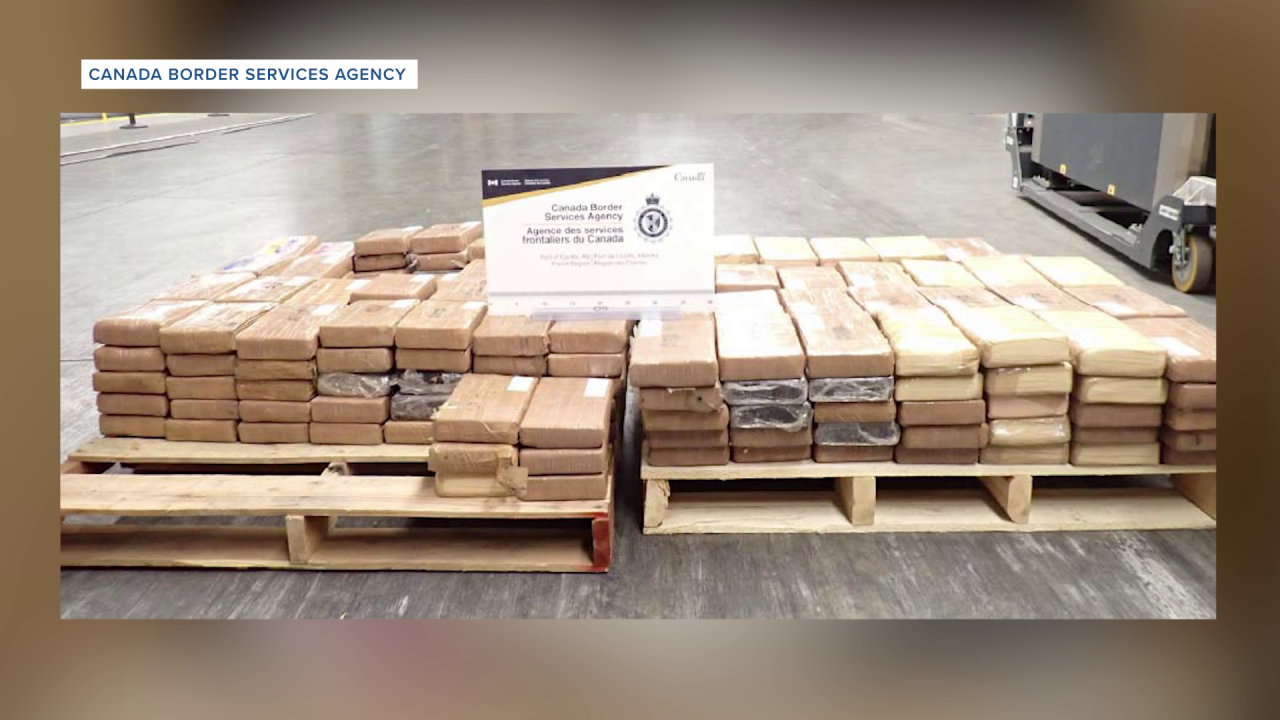


Officers with the Canada Border Services Agency at the Coutts port of entry, across from Sweet Grass, Montana, seized more than 1,000 kilograms of illegal narcotics in three separate incidents last November and December.
The shipments, all coming from the United States and bound for Calgary, were intercepted before entering Canada. Each driver involved was arrested and turned over to the RCMP Federal Policing Northwest Region.
On November 26, officers inspecting a truck carrying electrolyte beverages discovered 461 kilograms of cocaine and 43 kilograms of suspected heroin. A small amount of opium was also found hidden in the cab. On December 2, a truck hauling an empty trailer contained 300 kilograms of cocaine and 400 grams of suspected opium poppies. The final seizure occurred December 18, when officers, with the assistance of a detector dog team, found 206 kilograms of methamphetamine hidden inside a shipment of vacuum parts. In total, 1,010 kilograms, or roughly 2,226 pounds, of narcotics were confiscated.
CBSA District Director Ben Tame, who oversees Southern Alberta and Southern Saskatchewan, said the port’s history of narcotics interceptions makes these seizures part of a long-standing effort.
“The Coutts port of entry has a significant history of interdicting large quantities of narcotics,” Tame said. “With these most recent interdictions, it’s not a new trend per se, but the quantities in these last three events were particularly substantial.”
Tame said the seizures highlight the vigilance of CBSA officers and the tools they use to intercept contraband. “Our officers are trained and equipped to assess goods and travelers entering the country and determine which require a closer look,” he said. “They use a combination of risk assessments, specialized training, technology, and detector dog teams to intercept contraband before it reaches our communities.”
In 2025, CBSA officers in Alberta were responsible for making 1,292 seizures of illegal narcotics, including 1,054 kg of cocaine and 279 kg of methamphetamine.
Tame added that while Coutts has historically been a major point of interdiction, the size of these shipments shows the ongoing challenges of cross-border drug trafficking. “The Canadian border is a secure border, but we don’t rest on our laurels,” Tame said. “We continue to look for innovative ways to make our processes even stronger, and we work closely with our partners in the RCMP and U.S. Customs and Border Protection to disrupt criminal activity.”
The Canadian government recently announced $1.3 billion to strengthen border security, including funding for additional frontline staff, new technology, and expanded detector dog teams. Tame said those investments are critical to supporting CBSA officers in their mission.
“Officers are standing on guard for Canada,” he said. “They’re very vigilant in the work they’re doing to prevent illicit narcotics from entering our communities and harming the people we are sworn to serve. And we do all of this in close collaboration with our U.S. border counterparts, working together to keep our communities safe.”
