

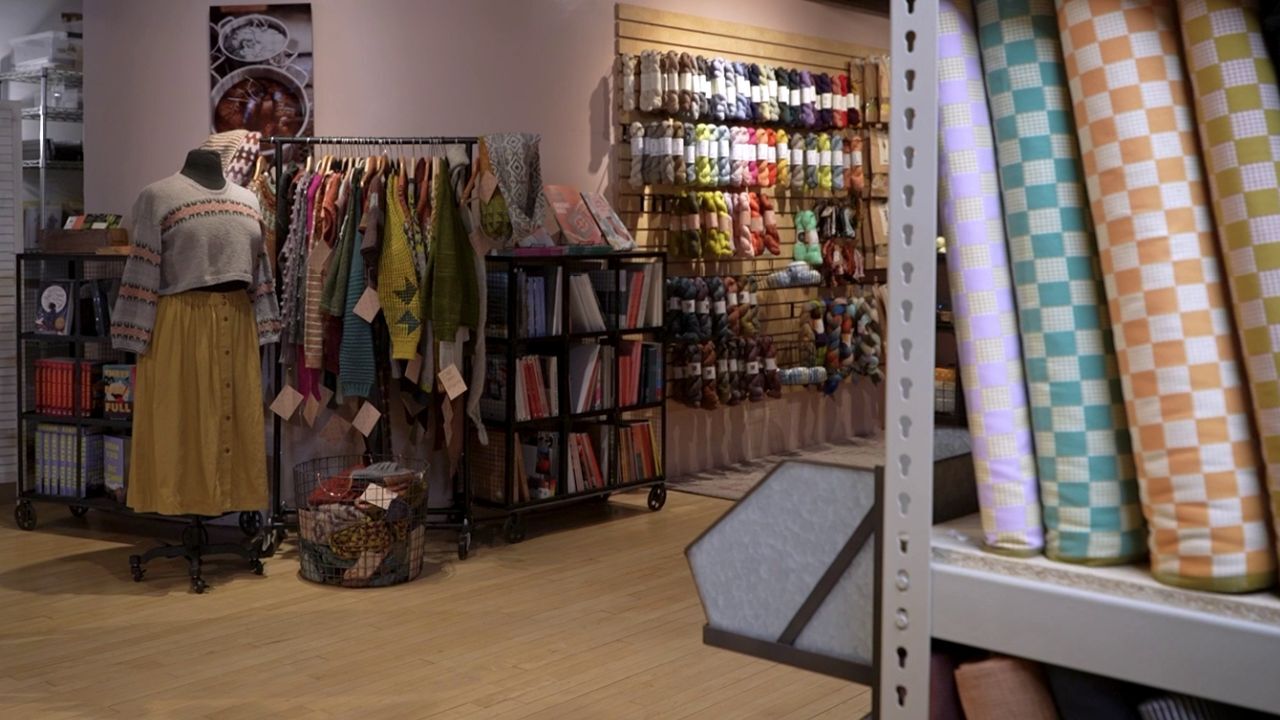


GREAT FALLS — What started as a creative outlet in a basement has grown into a destination yarn shop at 320 Central Avenue in Great Falls, with customers and makers from around the world drawn to quality wool, hand-dyed colorways, and the stories woven into every skein.
Founded ten years ago by Candace English, The Farmer’s Daughter Fibers (website) began as a leap of faith fueled by a love of knitting and fiber arts. At the time, English was working in early childhood education, a career she loved but one that offered little financial stability.
Madison Collier reports - watch the video here:
“I was a knitter; I loved knitting. It was my passion,” English said. “I knew I wanted to do something with fiber arts, but I also knew I needed something that could support my family.”
With encouragement and start-up help from her brother, English purchased dye pots, supplies, and yarn, transforming part of her home into a makeshift D-I-Y dye studio. From the beginning, she focused not just on the product, but on building a recognizable brand, one rooted in storytelling and Montana identity.
That focus paid off quickly. In the early years, English took every opportunity she could, from farmers' markets to local shows and regional fiber festivals. Each event helped fund the next, gradually expanding the business and its reach.
“It grew really fast,” she said. “At the time, I wouldn’t have imagined it becoming a family business.”
Today, it is exactly that. English’s husband left his career to work alongside her, and their son now works full-time in the business as well.
At the heart of The Farmer’s Daughter Fibers is a detailed, hands-on dye process. The yarn arrives already spun, sourced primarily from Wyoming and Montana Rambouillet wool. Much of it is non-superwash, untreated wool that has become one of the company’s most popular bases among knitters.

Each skein is unpacked, secured with reusable ties, soaked to prepare the fibers, and then dyed by hand. On busy days, the team dyes roughly 100 pots of yarn, a pace that reflects the scale the business has reached without sacrificing quality.
After dyeing, the yarn is allowed to exhaust, rinsed, dried, and then skeined, labeled, and prepared for sale. While about 95 percent of the company’s business happens online, the Great Falls storefront plays an equally important role.
“There’s something really special about our storefront that you can’t quantify,” English said.
Designed to be welcoming, even for people who don’t knit, the shop features yarn alongside books, jewelry, bags, and other goods. English said that intentional openness helps remove the intimidation some people feel when walking into specialty craft spaces.

The shop has also become a destination for visitors traveling through Montana. Many customers plan stops in Great Falls specifically to visit the store, bringing added foot traffic and attention to downtown.
Storytelling continues to be central to the brand. English, who grew up on a ranch between Browning and Cut Bank and has lived across the state, draws inspiration from Western life and Blackfeet culture when naming colorways and designing collections.
“So much of what Farmer’s Daughter is about is storytelling,” she said. “Those cultural references are really the foundation of what we do.”

Beyond production and retail, the community has become another defining piece of the business. The company offers classes, one-on-one lessons, retreats hosted in Great Falls, and an active online Discord group where knitters from around the world share projects and support one another.
Looking ahead, English says the next chapter is focused on sustainability and deeper support for Montana wool growers. Having grown up around agriculture herself, she sees firsthand the impact fiber businesses can have on local producers.
“To be able to use Montana wool for our medium just feels really good,” she said. “It’s exciting to know the impact we can have.”
Ten years after dyeing yarn in a laundry room, The Farmer’s Daughter Fibers continues to grow, blending craft, culture, and community while keeping Montana at the center of every strand.
